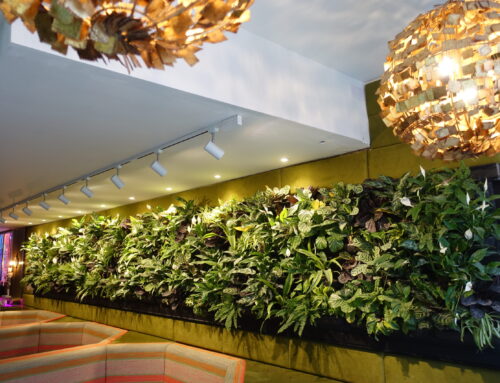
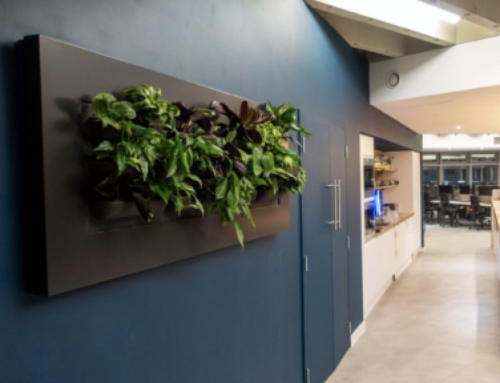
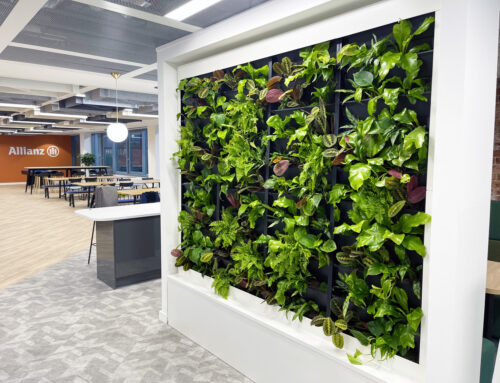
There are now many reports to substantiate the fact that living walls can improve well-being at work.
An internal living wall not only visually improves a workplace environment, but is proven to significantly improve air quality and the productivity of employees.
Living walls are now considered part of the climate-proof construction and good practice in maintaining staff welfare. Companies lose millions a year from absenteeism. A living wall can offer a solution to ‘sick building syndrome’ where employees begin to experience health problems due to the build-up of toxins and poor ventilation, especially in older properties, and buildings where airflow is a problem.
A living wall can showcase your branding, or work as a division between reception and workspace. A living wall can be incorporated at the design stage or as an added feature on any suitable wall space.
Does a Living Wall improve air quality?
NASA Space Centre has been researching the use of plants to generate better air quality and has found a reduction in pollutants when plants are present.
The average British person spends 90% of their time indoors, so cleaner internal air quality is essential. A living wall is very simple to install, a small design can be done in as little as a day.
A living wall not only improves air quality but provides a visual break from computer screens reducing eye, neck and back strain, helping employees to keep up with the 20/20 rule, 20 minutes of screen time, 20 seconds stretching and focusing on something further away. An internal living wall provides visual comfort for employees, plus a living wall creates an uplifting design feature and an alternative to traditional wall art.
What toxins does a living wall remove?
A living wall can alleviate common contaminants in buildings from electronics, upholstery, printers, plastic, carpets and copiers. Plants work on the purification process, converting carbon dioxide into oxygen. A living wall can help to purify the air and reduce ambient temperature and the need for constant air conditioning.
Through photosynthesis a living wall can remove these contaminants:
Formaldehyde (CH2O, and Carbon Monoxide (CO), from heating systems. Volatile Organic Compounds (VOCs) from flBenzene (C6H6) / Toluene (C7H8) / Xylene (C8H10)
Is a living wall easy to install?
Our living walls are easy to install and is available in a range of sizes and designs and do not require extensive plumbing or electrical support. Our mobile living wall uses a hydroponic system which minimises issues with maintenance, making it a smart choice for office managers.
An internal living wall comes with a built-in LED grow light which emits natural light, providing an optimal environment to ensure plants continuously thrive.
Recommended plants for a living wall include:
Peace lily, Boston fern, English ivy, Golden Pothos and Orchids.
At A Greener London every one of our projects is unique, with your company ethos and staff welfare at the center of the design.
For more information on how we can help you create a healthier, happier greener working environment contact 020 8543 2459.